A guide
Tile patterns, in plain English.
Two rooms can be tiled with exactly the same tile and look nothing alike. What changes is the bond — the way the tiles are set out against each other. Here is what each one is called, what it does to a room, and what it costs you in cutting and waste. Worth five minutes before you pick a tile, because some tiles only work in some bonds.
Straight stack bond
Grid · straight set
Every tile sits directly above and beside its neighbour, so the grout lines run in continuous straight lines both ways.
The calmest, most modern of the lot. It suits large-format tiles and rectified edges, where the grid itself becomes the pattern. Unforgiving of an out-of-square room, because every joint is a straight line for the eye to check.
Cutting & waste — Low waste, but demands a flat, true substrate.
Vertical stack bond
Stacked · column set
Rectangular tiles stood on end and stacked in columns rather than laid on their long edge.
Adds height. On a low-ceilinged bathroom — and most Altrincham semis have one somewhere — running a metro tile vertically instead of horizontally lifts the room without changing a single material.
Cutting & waste — Low waste. Needs a straight vertical set-out or the columns visibly lean.
Brick bond
Running bond · half-brick · offset
Each row is offset from the one below, traditionally by half a tile.
The default for metro and subway tiles, and the friendliest bond there is: the offset disguises small variations between tiles and small deviations in the wall.
Cutting & waste — Low. The half-tile cut off one end usually starts the next row.
Third bond
One-third offset
The same idea as brick bond but offset by a third rather than a half.
The right choice for long, large-format planks and slabs. A half-offset on a very long tile puts the centre of one tile against the end of its neighbour, which is exactly where a slightly bowed tile shows most — a third offset keeps that difference small.
Cutting & waste — Moderate. Cuts don't recycle as neatly as a half-bond.
Diagonal
Diamond set
Square tiles turned through 45 degrees.
Makes a small floor read as wider, because the eye follows the diagonal across the room rather than square to the walls. Classic in hallways and small cloakroom floors.
Cutting & waste — Higher — every perimeter tile is a cut, and every one is a triangle.
Straight herringbone
Single herringbone
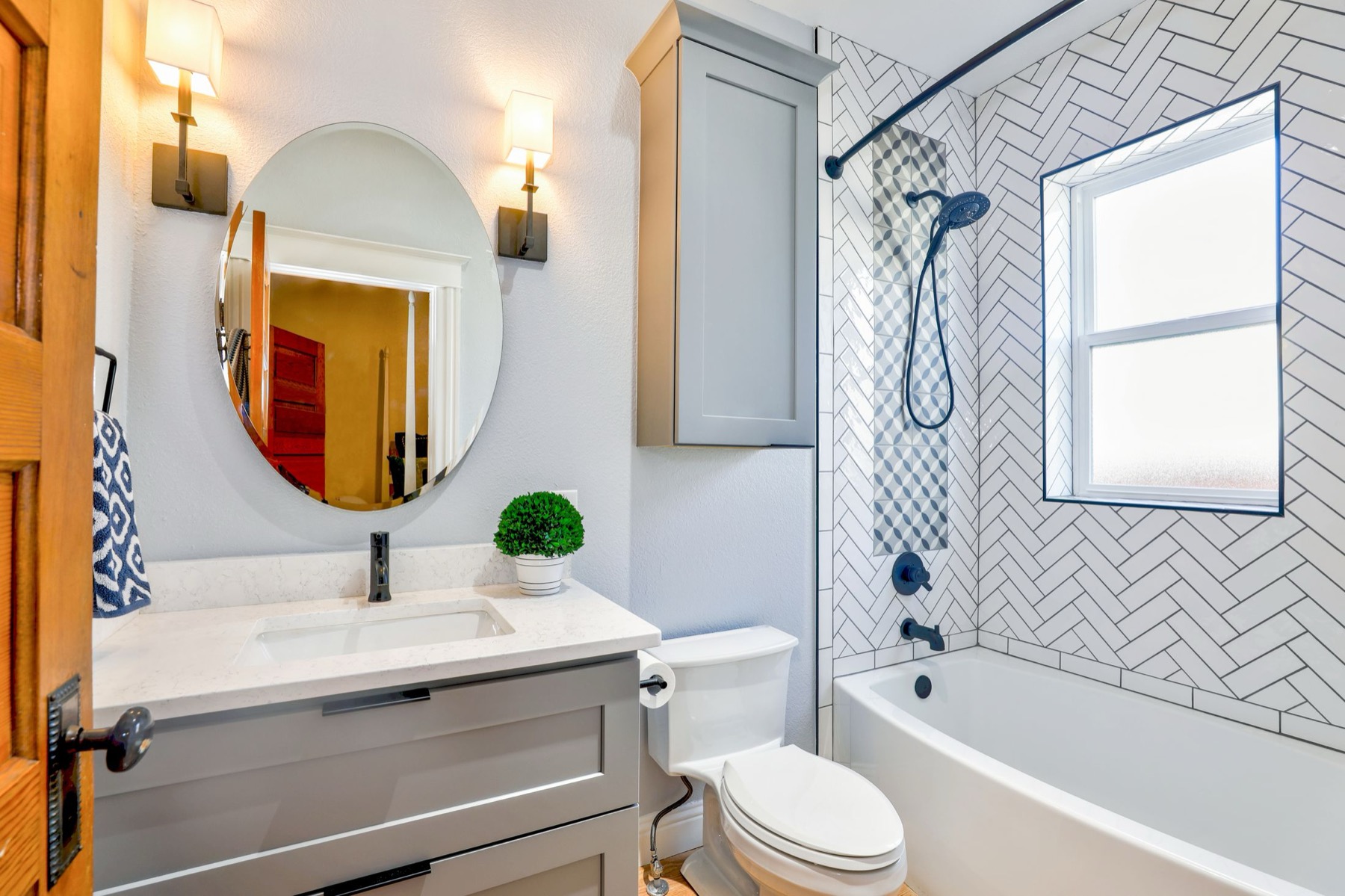
Rectangular tiles laid in interlocking Ls, running square to the walls.
Texture and movement without colour. Works beautifully on a shower wall or a chimney breast in a plain tile, where the pattern does all the work. Popular in a 2:1 tile, which interlocks perfectly.
Cutting & waste — High — the perimeter is all angled cuts. Order extra.
Diagonal herringbone
45° herringbone
The same interlocking Ls, but the whole pattern rotated to run at 45 degrees to the room.
Softer and less rigid than straight herringbone, and it hides an out-of-square room rather than advertising it. The set-out is the fiddly part — get the centre line wrong and it never recovers.
Cutting & waste — Highest of the common bonds.
Chevron
Point de Hongrie
Looks like herringbone at a glance, but the tiles are cut at an angle so the ends meet in a continuous point rather than an L.
Sharper and more formal than herringbone. Needs purpose-made chevron tiles, or a lot of mitring — it is not a pattern to improvise on site.
Cutting & waste — High, and the tile itself usually costs more.
Victorian geometric
Encaustic-style floor
Small shaped tiles — squares, triangles, hexagons — built up into a repeating border-and-field pattern.
The right floor for a Victorian or Edwardian hall, porch or cloakroom, and a lot of the housing stock round Altrincham and Bowdon is exactly that. Laid out from a drawn centre line with the border set first.
Cutting & waste — Moderate, but the labour is where the real cost sits.
Wood-effect plank
Puzzle wood · timber-look porcelain
Long, narrow porcelain planks printed as timber and laid in a staggered bond like a wooden floor.
Warmth of a wooden floor with none of the worry about water — so it belongs in bathrooms, kitchens and halls, and it takes underfloor heating happily, which real timber doesn't always. Lay it to a third bond, not a half.
Cutting & waste — Moderate. Plan the stagger so no two end joints line up.
Before you order
Three things worth knowing at the tile shop.
Pick the bond before you buy the tile
Herringbone wants a tile whose length is exactly twice its width. Chevron wants a tile cut on the angle at the factory. Large-format slabs want a third bond, not a half. Choosing the tile first and the pattern afterwards is how people end up unable to have the pattern they wanted.
Order more than the room measures
A straight bond might need ten per cent over. A diagonal herringbone can need twenty or more, because every edge is an angled cut and a cut tile rarely gives you a second usable piece. Buying short means a second batch, and a second batch means a slightly different shade.
Batch numbers matter
Tiles are fired in batches and the shade varies between them. Check the batch numbers on every box before anything is opened, and work out of several boxes at once rather than one at a time, so any variation is spread evenly across the wall instead of appearing as a visible band.
Got a tile picked out and no idea which bond suits it?
Send a photo of the tile and the room to the email below. We will tell you what it will and will not do, and roughly how much extra to order for the pattern you are after.
We're on the tools most of the day, so a text or a voicemail is never ignored — we ring back the same day.